
In the current power market environment, the competitive focuses of energy storage projects are shifting from "Capacity Scale" to "Delivery Certainty."
For IPPs and large-scale developers, the factors truly impacting project IRR (Internal Rate of Return) are often not minor differences in system efficiency, but rather:
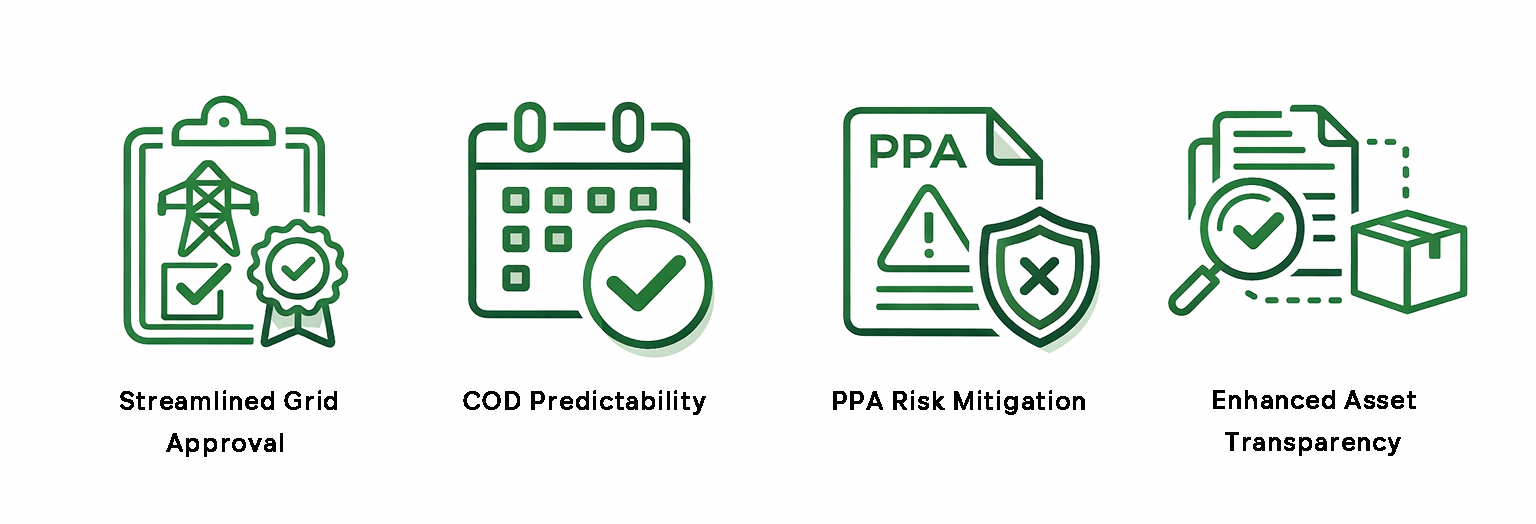
As global grid queues continue to grow and approval cycles lengthen in 2026, the development cycle itself has become a critical financial variable affecting project returns.
This paper explores how Renon Power upgrades energy storage projects from “Engineering-Based Delivery” to “Certainty-Driven Asset Delivery” through its 10ft distributed energy storage solution and C&I cabinet all-in-one solution.
Under current market conditions, energy storage development commonly faces three primary pressures:
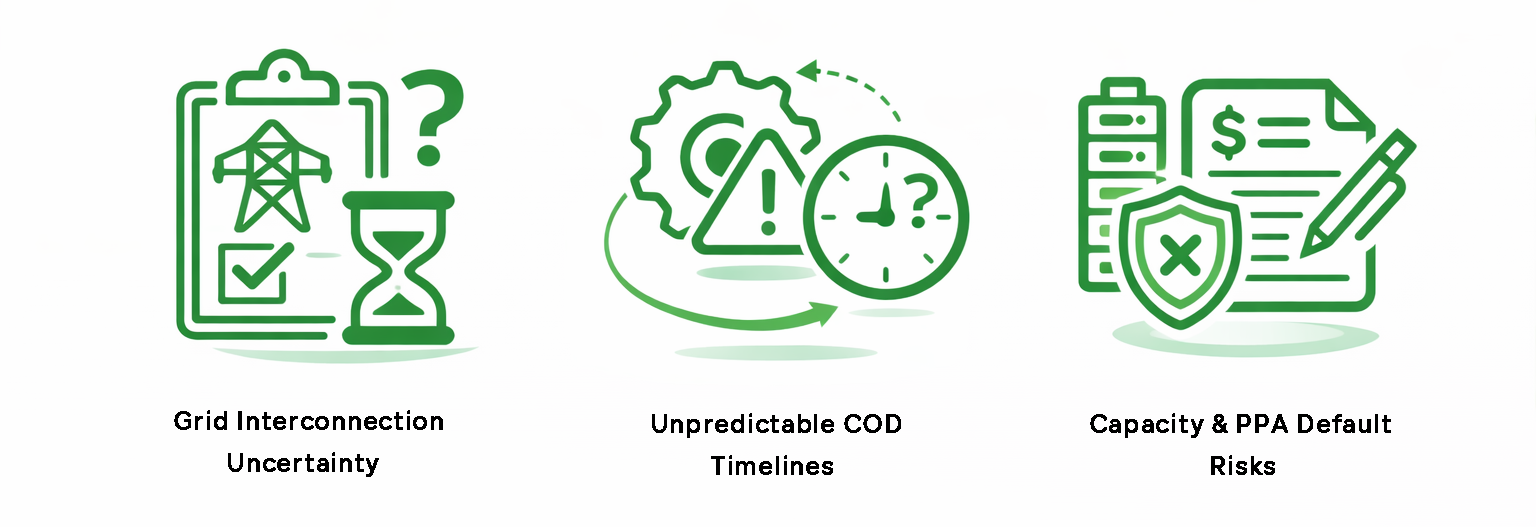
The Financial Impact (Example: 100MW Project):
Time has become a critical financial variable.
For IPPs, centralized energy storage has long been the most economical path. Its highly integrated architecture provided clear engineering boundaries and a lower CAPEX threshold, solving key issues during the era of rapid scale expansion:
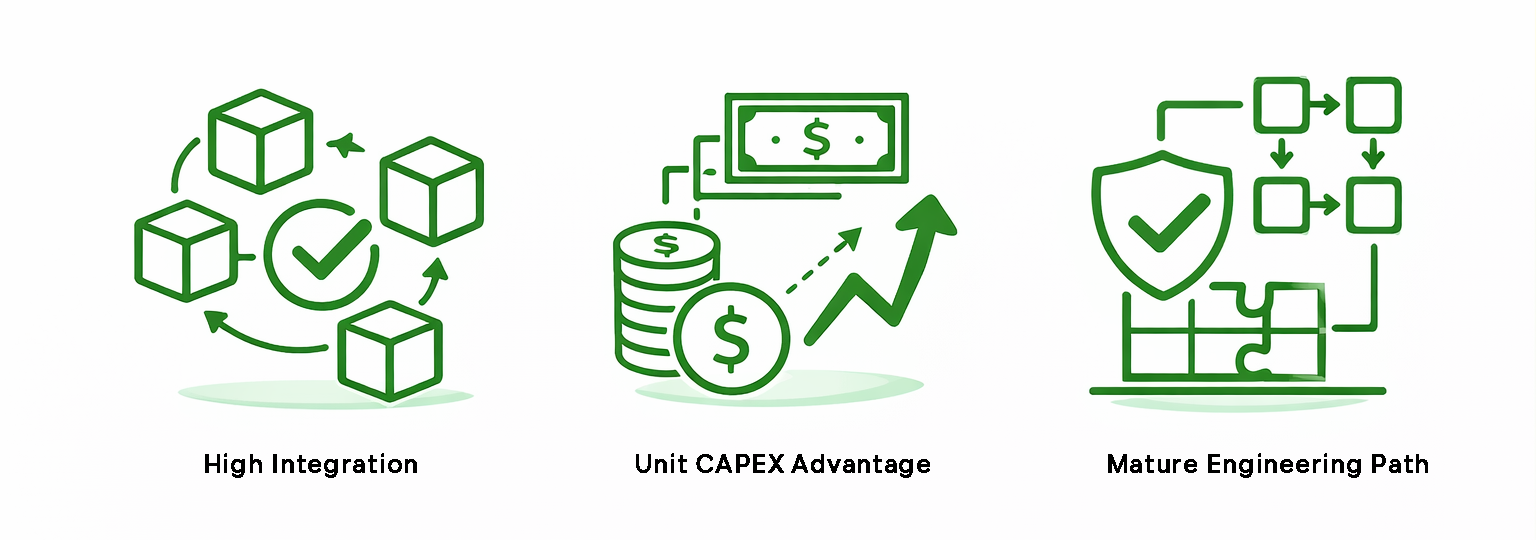
In environments with sufficient land availability, relatively lower interconnection pressure, and longer construction timelines, centralized energy storage provides IPPs with:
However, as grid congestion increases and regulations tighten, the structural limitations of centralized systems—such as high impact from single-point failures and complex system-level commissioning—limit development flexibility. When the objective shifts from "Scale First" to "Certainty First," the criteria for architectural choice must evolve.
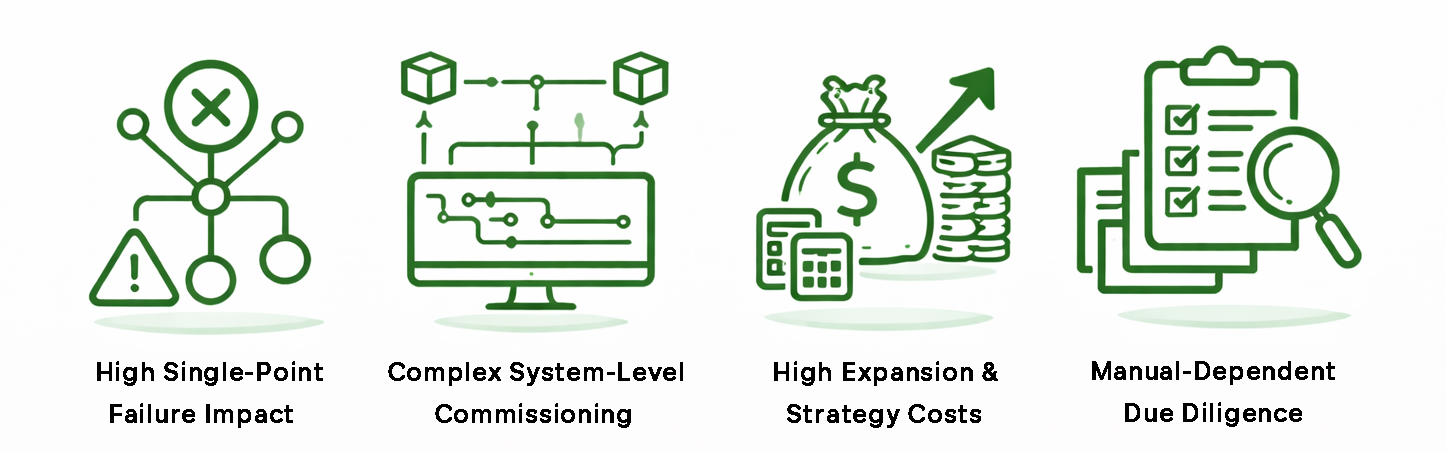
Distributed energy storage shifts the focus from scale to granularity. By decomposing risk to the module level and commissioning to the unit level, it offers significant advantages:
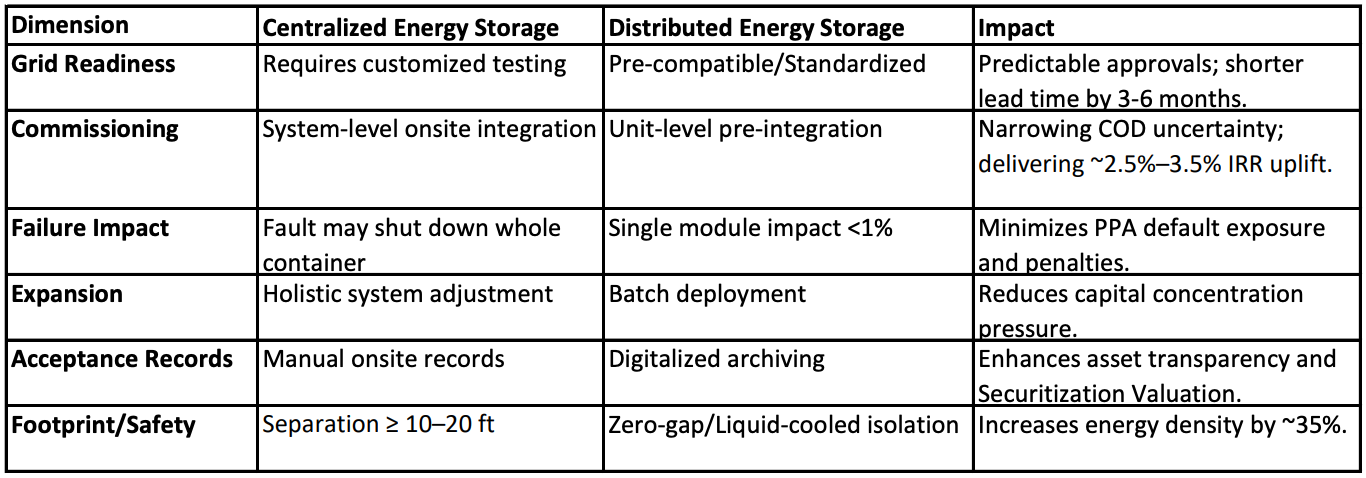
However, it must be emphasized that distributed energy storage increases the number of system nodes. Without a unified governance framework, system complexity may rise.
Therefore, the advantage of distributed energy storage depends on whether a system-level delivery governance framework is established.
Renon’s solution is built on a three-tier architecture: "Node Autonomy – Station Coordination – System Dispatch."
(Right-click to open video in a new tab)
Its core value lies in supporting pre-configuration and pre-commissioning, enabling standardized, fully assembled transportation and rapid deployment. By reducing on-site installation and wiring complexity, engineering uncertainty is lowered and start-up timelines become more predictable.
At the same time, potential outage risks are confined to the module level, preventing full-site capacity shutdowns.
(Right-click to open video in a new tab)
Through matrix-based deployment, it ensures dispatch consistency, eliminates single points of failure, and enables module-level replaceability. It combines centralized dispatch efficiency with distributed risk isolation.
In modern systems, distributed Battery Energy Storage System (BESS) architectures are becoming increasingly common. Each battery module or cabinet operates semi-independently, with every module having its own Battery Management System (BMS), protection system, monitoring, and sometimes Power Conversion System (PCS). If one module fails, the rest of the system continues operating, providing higher reliability and easier scaling, which brings many benefits.
However, distributed BESS architectures also come with risks, including incomplete technical documentation, misaligned specs between inverters, and battery vendors, permitting issues, grid interconnection changes, warranty and service misunderstandings, and more.
Thus, certainty comes from process control, not just good equipment. Hardware alone doesn’t guarantee the success of energy storage projects. Our Standardized Asset Delivery Framework ensures bankability, project certainty, and asset performance guarantee.
The Standardized Asset Delivery Framework consists of two parts: 15 Standard Packs and the DLV 9-Piece Framework.
These components can be replicated, used, and referred to as experience and standards. Under the Standardized Asset Delivery Framework, every phase of the project provides clear deliverables. Through this standardized approach, projects become more predictable, transparent, and easier for developers to finance and build.
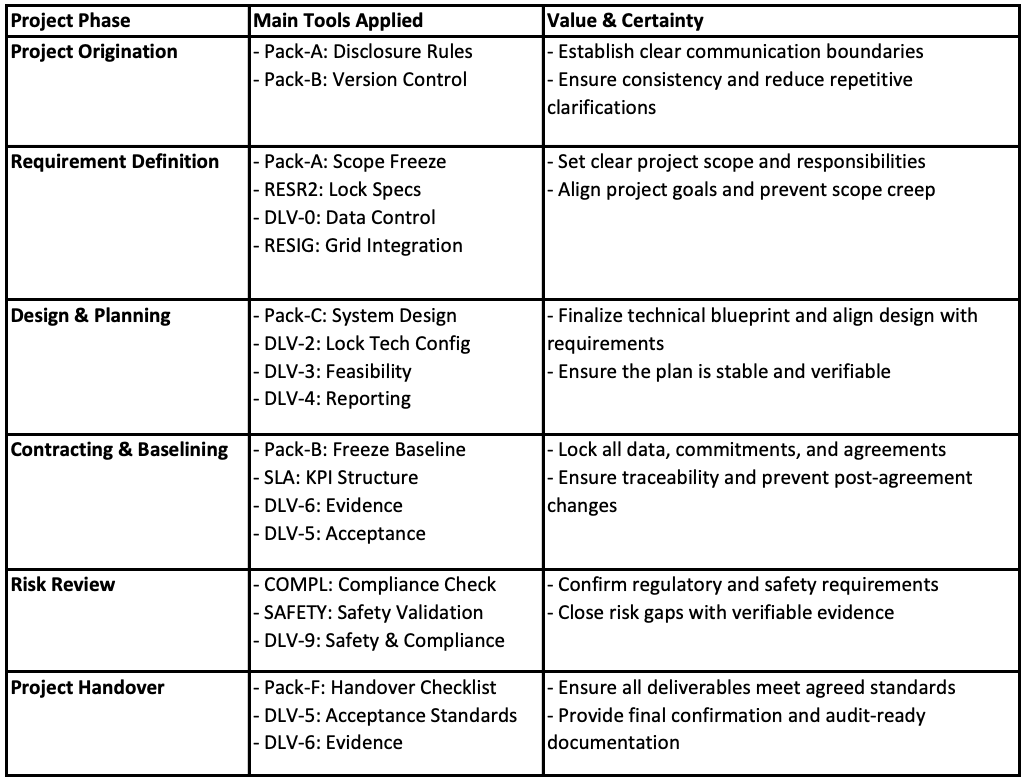
The energy storage industry is entering a new competitive phase, where the core competitive advantage in project development has gradually shifted towards "certainty." While capacity scale remains important, factors such as development speed, structural risk control, and asset transparency are becoming increasingly crucial.
In different application scenarios, centralized and distributed architectures are not simply alternatives but have their own merits in various contexts. However, as grid connection pressure and delivery complexity continue to rise, managing project architecture through standardized engineering paths and deterministic delivery processes will effectively mitigate uncertainties, reduce risks, and thus secure new development premiums.
Opting for distributed energy storage solutions with a Standardized Asset Delivery Framework ensures that every phase of project delivery is controllable and transparent, ultimately helping to achieve higher returns and stronger market competitiveness.
•Empowering Homes Globally: Renon Power's Residential Energy Solutions2024-05-27
•Sustainable Energy Solution in Ibaraki-ken2024-05-27
•Advanced Agricultural Energy Solution in Fukushima2024-05-28
•Innovative Energy Integration in Oita Prefecture2024-05-28
•Innovative Energy Storage Solution in Oita Prefecture Transforms Agricultural Efficiency2024-06-11
•Innovative Energy Storage Solution Transforms Agricultural Efficiency2024-06-11
•Comprehensive Showcase of Renon Power's Diverse Energy Storage Solutions2024-06-11
•Comprehensive Showcase of Renon Power's Diverse Energy Storage Solutions2024-06-11
•A Deterministic Development Framework for IPPs and Large-Scale Developers2026-03-24