
The U.S. solar‑plus‑storage landscape is growing more complex.
Installers can no longer rely on simple equipment matching to deliver reliable long‑term project outcomes. Retrofit activity is rising, utility rules keep shifting, and homeowners and commercial buyers are prioritizing backup resilience, system expandability and clear long‑term support ownership. Every project requires careful verification before proposals are locked in.
Against this evolving industry backdrop, Renon Power presents Renon Battery Banter, a podcast series bringing together industry partners and subject‑matter experts to unpack real‑world trends, pain points and technical best‑practices shaping North America solar and energy storage.
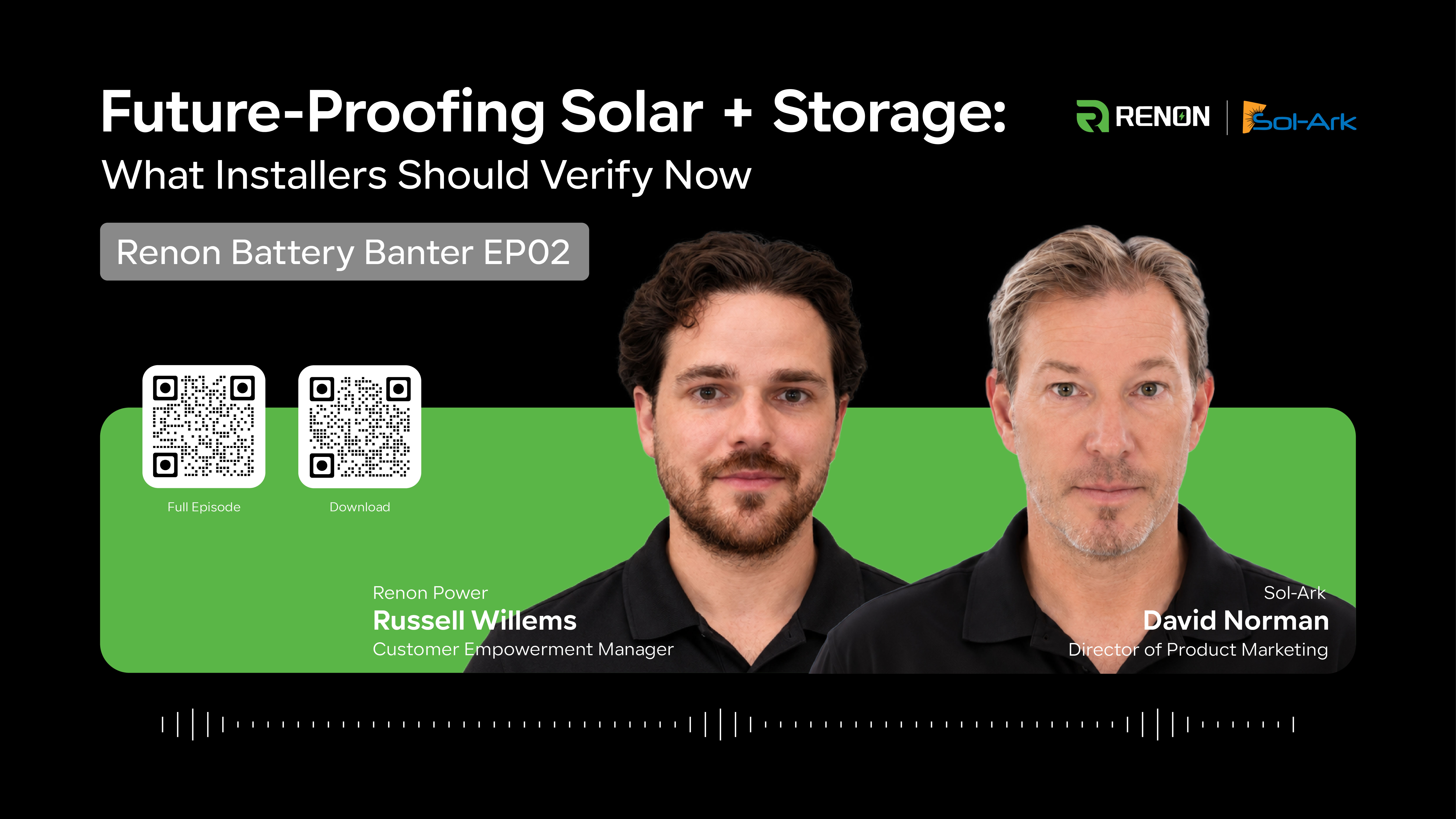
In Episode 02, “Future‑Proofing Solar + Storage: What Installers Should Verify Now”, Russell Willems, Customer Empowerment Manager at Renon Power, sits down with David Norman from Sol‑Ark. They break down the growing retrofit market, backup readiness requirements, modular system architecture, and the critical verification steps installers should complete before specifying any solar‑plus‑storage project.
Renon Power develops advanced battery energy storage solutions for residential, commercial & industrial, and utility‑scale applications, emphasizing safety, modular scalability and cross‑inverter compatibility.
Sol‑Ark brings deep field‑proven expertise in hybrid inverter design, AC‑coupled retrofits and integrated energy management for installers across the United States.
Together the two companies support installers navigating today's fast‑changing market, where model‑level hardware verification, retrofit planning and clear support accountability are critical to project success.
Modern solar‑storage work goes far beyond picking a battery and inverter combination. Russell and David highlight core market shifts impacting every installer’s day‑to‑day proposal and commissioning workflows.
Growing Retrofit Demand
Large numbers of existing solar sites are looking to add storage after initial installation. Retrofit projects introduce unique constraints around existing wiring, system limits and interconnection rules that cannot be treated identically to new‑build installs.
Backup Readiness as a Core Requirement
Homeowners and commercial customers increasingly evaluate systems based on outage performance. True backup capability depends on full‑system validation — not individual product datasheet specifications alone.
Modular Architecture and Expandability
Buyers want systems that can grow alongside future energy needs. Modular hardware offers flexibility, yet installers must confirm exact supported configurations, stacking limits and communication compatibility before quoting.
Evolving Policy & Compliance Context
Regulatory, utility and certification requirements continue to update across states and jurisdictions. Relying on outdated assumptions creates project risk; installers must verify current rules for each individual deployment.
What You'll Learn in This Episode
Retrofit Project Considerations
When adding storage onto pre‑existing PV, installers must audit the existing inverter, wiring limits and interconnection constraints. Not every legacy solar array supports straightforward battery retrofitting without adjustments.
Backup & Resilience Validation
Reliable outage performance requires reviewing critical load profiles, system transfer logic and real‑world commissioning steps. Datasheet claims do not guarantee site‑specific backup outcomes.
Modular‑System Boundaries
While modular designs support future expansion, every platform has hard limits for parallel units, AC‑coupling setups and energy capacity. All deployed configurations should reference officially approved documentation.
Ongoing Support & Training
Successful deployments extend past the commissioning date. Understand where technical support originates, how firmware updates are delivered, and what training resources are available for your installation team.
Watch the full episode for the complete conversation, or download the Open Ecosystem & Backup System Selection Checklist* to bring structured verification steps to your next solar‑plus‑storage proposal.
*Product compatibility and policy requirements vary by model, configuration, project and jurisdiction. Verify current documentation before specifying a system.
•Sustainable Energy Solution in Ibaraki-ken2024-05-27
•Advanced Agricultural Energy Solution in Fukushima2024-05-28
•Innovative Energy Integration in Oita Prefecture2024-05-28
•The New Installer Playbook: Selling Solar + Storage in a Changing U.S. Market2026-09-02
•Future‑Proofing Solar + Storage: What Installers Should Verify Now2026-10-16
•Empowering Homes Globally: Renon Power's Residential Energy Solutions2024-05-27
•Innovative Energy Storage Solution Transforms Agricultural Efficiency2024-06-11